This is my 100th post! In celebration, I'd like to do something very cliche: write a post about my favorite fantasy cliches. (Cue applause.)
Also, please note that in my blog post, I've used male pronouns to refer to characters, since the majority of fantasy stories are still written about males. Hopefully someday the case will be different!
So, without further ado, I present:
My Favorite Cliches
To the tune of, "My Favorite Things"
Dark stormy nights and scales on dragons
Bright shining daggers and red glowing fire
Stacks of old parchment all tied up with strings--
These are a few of my favorite cliches.
Black or white horses and elvish lembas bread
Watch bells and beacons and Gollum with worms
Creatures that fly with the Nazgul on their wings--
These are a few of my favorite cliches.
Shield maidens in white dresses with swords at their sashes,
Arrows that barely scratch my nose and eyelashes
Silver white beards of wise old men who soon die--
These are a few of my favorite cliches.
When the Dark Lord rises, when the prophecy rhymes, when the hero's an orphan,
I simply remember my favorite cliches, and then I don't feel so bad (about my own writing)!
And now for a proper list of my favorite fantasy cliches.
1. Stock characters
Almost every single fantasy story contains an old man/wizard/wise person who imparts crucial information to the young hero, usually an orphan. Said young hero discovers he has magic powers or is the "chosen one," a fact that no one has told him all his life, and that the villains have only just discovered. Add in a handful of warrior maidens and a dragon or two, and you've got a regular soup of cliches. If you really need any examples of this, just look to Lord of the Rings or Harry Potter.
2. Prophecies or curses
Speaking of the "chosen one," any prophecy or curse of any size or shape definitely counts as cliche. Particularly if the hero is the only person that the prophecy could refer to. And if the stakes are "the end of the world as we know it." So if you're dying to make your story as cliche as possible, please, please, insert one of these. I promise it'll increase the cliche-factor by ten. Don't believe me? Ask the dishes! (Reference to Beauty and the Beast, which by the way contains a prophetic curse.)
3. Medieval setting
Despite the constant use of Medieval costumes and weapons in fantasy stories, the hygiene and medicine of fantasy stories seem to be pretty modern. Because, really, where's the plague? Furthermore, there's always a journey that takes days or weeks to get to the destination, usually by walking or riding the same horse for days on end. Honestly, how do characters in these stories manage to get anything done when they must be dead tired from traveling all the time? Walking kills your feet, kills the horses, and can't be done constantly. I'm looking at you, Lord of the Rings.
4. Good versus Evil
So your hero is battling a "Dark Lord" or the "forces of evil" or must go through the "Dark Forest" and battle an army of ugly evil orcs? Wow, how original. But let me ask a question: why should darkness be the enemy just because it's dark? Couldn't that be construed as a bit racist? And why should the whole race of elves (or dwarves, or men) be good and beautiful while orcs (or other villainous force) are always evil and ugly? The real world has good ugly humans and bad beautiful humans. Why should fantasy be any different?
5. Unrealistic fighting
Hero learns swordplay in about a week and is suddenly a master at weapons of any kind, able to confront expert enemies who've had years of training to perfect their technique. Also, arrows never, ever run out, armor is feather-light, and shields are hardly ever necessary. Oh, and while we're on the subject, all wounds seem to be either a minor scratch or life-threatening. Don't heroes ever get paralyzed, or suffer brain damage, or have to amputate their arms?
That said, of course, these particular cliches are only cliches because they've been used very effectively in some of the greatest fantasy stories of all time, from Lord of the Rings to Harry Potter and Beauty and the Beast. So should you really always avoid using cliches?
Well, on the one hand, if you purposefully try to avoid all cliches ever, you're just going to give yourself a horrible headache while you try to think of original plot devices and methods of transportation. On the other hand, you do want to think very carefully before inserting a cliche into your story.
If you do use a cliche, make it humorous and obvious, as Patricia C. Wrede does in her hilarious Enchanted Forest Chronicles. Or try turning it on its head, as Gail Carson Levine did in her amazing novel Ella Enchanted. Recognize the cliches in your writing--and run with them! Use them for your own benefit. It's the best way to write!
Have you read any books or seen any movies with cliches? Any cliche-breaking stories you'd love to share? What about in your own writing--love them? Hate them? Avoid them like the plague?
Showing posts with label Archery. Show all posts
Wednesday, July 16, 2014
Tuesday, January 31, 2012
Bows (And How to Use them in Your Fantasy Story)
Following up on the last post on Swords, I thought it might
be helpful to provide a complementary guide on bows. Now, again, this is a
simplification of a very complex subject, so this information is best used for
aspiring writers who just need a quick fact-check or a source of inspiration.
Now then, to business. I’ll begin, as I did with the Swords
post, by outlining a few of the various types of bows.
1. Training Bow
--This light bow is easy to draw
and is thus ideal for training beginning archers. The bowstring can be
tightened or loosened according to the level of ability. Because it’s so light and simple,
it’s not intended as a fighting weapon; it could perhaps be used for hunting,
but is mostly suited to target practice.
-- If your characters are in
training (either as archers or rangers or other military/protection forces),
than the training bow will be a good bet to start them off. Be sure to graduate
them to an actual bow, though, after their muscles develop!
2. Longbow
--The longbow is quite tall
(roughly the height of the person who uses it) and fairly slender. It’s widest
at the handle, where the archer grasps it. Historically, this bow came from the
English Longbow used during the middle ages and made particularly famous by
Robin Hood and by the success of various battles in the Hundred Years’ War. It
is quite a strong bow with a large shooting range, so it functions well for
both hunting and warfare.
--Among bows, the longbow is
generally lighter, quicker to prepare for shooting, and quieter. Additionally,
it is fairly simple in construction, so skilled carpenters (like Medieval
bowyers) could construct the longbow in just a few hours. The longbow can be
made from various woods, with yew being preferable and mulberry, elm, oak, ash,
hazel, and maple being acceptable substitutes. Because of the simplicity of a
longbow, it is ideal for a fantasy culture where there are large military
forces of archers who must be armed quickly or where bows do not play a primary
role in the action.
3. Recurve Bow
-- True to its name, the recurve
bow has tips that curve away from the archer when the bow is strung. Because of
its shape, the recurve bow stores and delivers energy more efficiently than a
strait bow (e.g. a longbow), which gives the arrows greater speed. At the same
time, the recurve bow is often a good deal shorter than a longbow, which makes
it lighter and easier to transport. A version of this bow, the Mongolian bow,
was the weapon of choice for the Mongol Horde during the Middle Ages, a force
that conquered most of Europe and Asia.
-- Because of its practicality and
range, the recurve bow is favored by mounted horsemen (like the Mongols).
However, since it’s so intricate, it’s also much more difficult to make. Thus,
the recurve bow would work best with a culture that hunts or wages war
primarily on horseback and has a long history of skilled craftsmen.
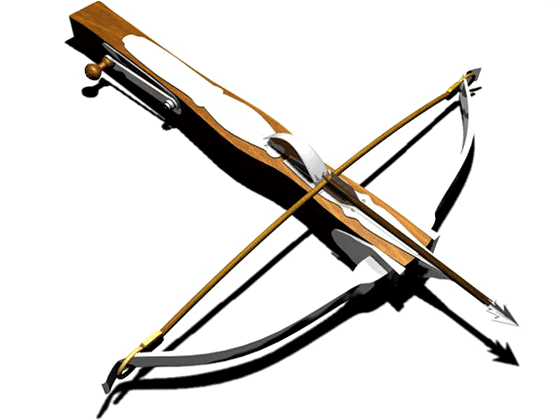
4. Crossbow
-- A crossbow is a special kind of
bow where the arrow is attached to a simple machine that holds it in a
ready-to-fire position until the “trigger” is releases it. Crossbow
construction ranges from a simple wooden mechanism to a much more complex
weapon incorporating several pieces of metal. Typically, crossbows are made of
a composite of wood, horn, and sinew that make them much stronger and more
efficient.
-- You may think that, because a
crossbow is a “simple machine,” that you can’t use it in your fantasy story.
The earliest known crossbows, however, date back to 5th century
B.C., during the time of the Ancient Greeks. Ancient Chinese also utilized this
weapon. If the ancients were smart enough to discover this weapon, why not your
fantasy cultures?
-- A longbow has a faster shooting
rate and are more accurate, but crossbows release more kinetic energy (thus
have greater speed and can penetrate harder surfaces, even armor).
Additionally, crossbows can be used after a single week of training, while
longbows may take years to build up the strength to draw and use it. It’s up to
you to decide whether or how to include the crossbow in your fantasy!
Included is a picture of the components of a recurve bow.
Generally, the parts labeled in that illustration may be applied to other bows,
as well; I’ve found them useful myself when detailing the specific actions of
an archer.
If you are writing extensively about bows, archery, or any
function thereof, get a good reference book from the library and be sure to do
your research. After all, nobody wants to write a climactic battle scene in
which the fate of the world hangs in the balance of one misshot inaccurate
badly-made arrow!
Subscribe to:
Posts (Atom)