Following up on the last post on Swords, I thought it might
be helpful to provide a complementary guide on bows. Now, again, this is a
simplification of a very complex subject, so this information is best used for
aspiring writers who just need a quick fact-check or a source of inspiration.
Now then, to business. I’ll begin, as I did with the Swords
post, by outlining a few of the various types of bows.
1. Training Bow
--This light bow is easy to draw
and is thus ideal for training beginning archers. The bowstring can be
tightened or loosened according to the level of ability. Because it’s so light and simple,
it’s not intended as a fighting weapon; it could perhaps be used for hunting,
but is mostly suited to target practice.
-- If your characters are in
training (either as archers or rangers or other military/protection forces),
than the training bow will be a good bet to start them off. Be sure to graduate
them to an actual bow, though, after their muscles develop!
--The longbow is quite tall
(roughly the height of the person who uses it) and fairly slender. It’s widest
at the handle, where the archer grasps it. Historically, this bow came from the
English Longbow used during the middle ages and made particularly famous by
Robin Hood and by the success of various battles in the Hundred Years’ War. It
is quite a strong bow with a large shooting range, so it functions well for
both hunting and warfare.
--Among bows, the longbow is
generally lighter, quicker to prepare for shooting, and quieter. Additionally,
it is fairly simple in construction, so skilled carpenters (like Medieval
bowyers) could construct the longbow in just a few hours. The longbow can be
made from various woods, with yew being preferable and mulberry, elm, oak, ash,
hazel, and maple being acceptable substitutes. Because of the simplicity of a
longbow, it is ideal for a fantasy culture where there are large military
forces of archers who must be armed quickly or where bows do not play a primary
role in the action.

-- True to its name, the recurve
bow has tips that curve away from the archer when the bow is strung. Because of
its shape, the recurve bow stores and delivers energy more efficiently than a
strait bow (e.g. a longbow), which gives the arrows greater speed. At the same
time, the recurve bow is often a good deal shorter than a longbow, which makes
it lighter and easier to transport. A version of this bow, the Mongolian bow,
was the weapon of choice for the Mongol Horde during the Middle Ages, a force
that conquered most of Europe and Asia.
-- Because of its practicality and
range, the recurve bow is favored by mounted horsemen (like the Mongols).
However, since it’s so intricate, it’s also much more difficult to make. Thus,
the recurve bow would work best with a culture that hunts or wages war
primarily on horseback and has a long history of skilled craftsmen.
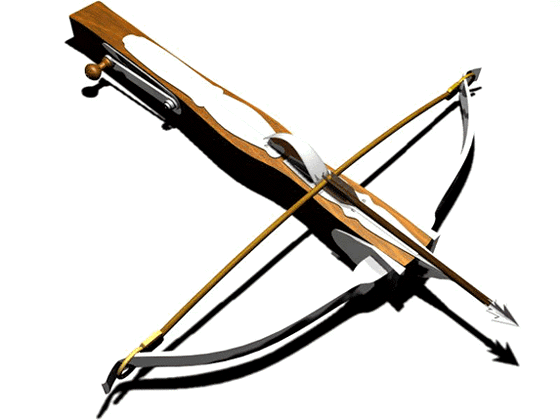
-- A crossbow is a special kind of
bow where the arrow is attached to a simple machine that holds it in a
ready-to-fire position until the “trigger” is releases it. Crossbow
construction ranges from a simple wooden mechanism to a much more complex
weapon incorporating several pieces of metal. Typically, crossbows are made of
a composite of wood, horn, and sinew that make them much stronger and more
efficient.
-- You may think that, because a
crossbow is a “simple machine,” that you can’t use it in your fantasy story.
The earliest known crossbows, however, date back to 5th century
B.C., during the time of the Ancient Greeks. Ancient Chinese also utilized this
weapon. If the ancients were smart enough to discover this weapon, why not your
fantasy cultures?
-- A longbow has a faster shooting
rate and are more accurate, but crossbows release more kinetic energy (thus
have greater speed and can penetrate harder surfaces, even armor).
Additionally, crossbows can be used after a single week of training, while
longbows may take years to build up the strength to draw and use it. It’s up to
you to decide whether or how to include the crossbow in your fantasy!
Included is a picture of the components of a recurve bow.
Generally, the parts labeled in that illustration may be applied to other bows,
as well; I’ve found them useful myself when detailing the specific actions of
an archer.
If you are writing extensively about bows, archery, or any
function thereof, get a good reference book from the library and be sure to do
your research. After all, nobody wants to write a climactic battle scene in
which the fate of the world hangs in the balance of one misshot inaccurate
badly-made arrow!