Monday, February 20, 2012

The Pros & Cons of Bryan Davis


Bryan Davis is a Christian fantasy author especially known for the Dragons in Our Midst and the Oracles of Fire series. He is one of the foremost Christian fantasy authors of this generation—in fact, I’ve found his books in local libraries from Arkansas to Asia.

Below, I’ve outlined some of the pros and cons of his work that I found when reading the Dragons in our Midst and Oracles of Fire series (I haven’t read any of his other works yet, so none of the comments below apply to them).

Pros:
o   One of the best things about these stories is the strong Christian themes found in each story. I love that Davis upholds the Christian ideas of redemption, sacrifice, sin, prayer, repentance, and so forth. He provides an excellent example of strong Christian elements yet exciting fantasy worlds and characters.
o   Davis’ Dragons in Our Midst and Oracles of Fire series contain a fascinating interpretive history of the earth spanning from creation through the modern age. I was enthralled and captivated by the creative ways in which Davis chose to weave events in our history—like King Arthur, the account of the Genesis flood, and Nimrod from the Old Testament—with his stories of dragons.
o   While I found some of his earliest writing (Raising Dragons, for example) a trifle stiff and plain, I have really enjoyed reading Davis’ progression as a writer into much more subtle and complex grounds in his later works.

Cons:
o   The stories may feel “pushy” to non-Christians, since they overtly advocate such activities as prayer and trust in God. However, since these books were written for a primarily Christian audience, this may not be a real issue.
o   As with all interpretive stories, Davis’ theology can be contended. For example, in Circles of Seven, the hero must travel through the seven “levels” of hell and be the human savior of the dragon race. While Davis does explain this in the story, some may feel rather squeamish about spiritual liberties taken therein.
o   For myself personally, I was not always satisfied with Davis’ writing style and with the plot of the stories themselves. Several times, I felt that the climaxes were forced by characters’ stupidity rather than their conscious choices. In addition, I disliked how some of the female characters felt like damsels-in-distress without much individual personality.

On the whole, despite the flaws mentioned above, I enjoyed Davis’ work and I would recommend it. As Christian fantasy writers, it’s important for us to see what others are doing well, and seek to imitate them. It’s also important to discuss them, so here’s a few questions to get you thinking:

If you’ve read any of Davis’ books, what did you think of them? Do you agree with the pros and cons I wrote above, or do you have some of your own to contribute? What elements in his stories make them “Christian” fantasy, and have you used any of these in your own writing?

If you haven’t read any of his books, then, without further ado, I point you in the direction of your local library: go get ‘em! (Don't let their size--or their dragons--intimidate you. They're worth the read.) Then come back and join the discussion :)


Friday, February 10, 2012

Review: Techniques of the Selling Writer


Techniques of the Selling Writer was recommended to me as “the best guide to writing fiction ever written” by the prominent author and writing coach Randy Ingermannson. I’ve found Randy’s (free) e-zine at Advanced Fiction Writing to be invaluable in my writing journey.

Anyway, he recommended the book Techniques of the SellingWriter—which, coincidentally, has been sitting on my shelf unread for about a year. So I dusted it off, dutifully poised my pencil to take notes, and began to read.

From the back cover:

This book provides solid instruction for persons who want to write and sell fiction, not just to talk and study about it. It gives the background, insights, and specific procedures needed by all beginning writers.

The lessons taught here are plain, practical good sense. The book gives you concrete tools for how to construct your book, but encourages you to follow your own feelings—the perfect balance of freedom and instruction.

Swaine is not didactic, but his approach to writing is strongly motivated by years of teaching and publishing his own writing. In the book, he covers the following lessons:

~ a basic understanding of words and how (not) to phrase them

~ how to group individual words into “motivation-reaction units,” where some cause inspires some effect on the one or two-sentence level

            ~ how to group motivation-reaction units into scenes and sequels

            ~ how to group scenes and sequels into story pattern

            ~ how to create the kind of characters that give a story life

            ~ and assorted tips for writing and publishing excellently

Each chapter is full of entirely practical steps, and I cannot emphasize enough how they have transformed my writing. In particular, his recommendations for building conflict have been absolutely invaluable to revitalizing my limp, dragging, actionless stories.

This book is not specifically for fantasy writers—because it is so inclusive that it spans genres. If you’re at all interested in seriously writing a story that others would want to read, then learn from this book! Read it and apply what you learn to your writing. If you’re anything like me, you won’t regret it.

Be sure to get it here! (P.S. I am not endorsed to write any of this. If I start doing Google Ads or Amazon affiliates, I'll be sure to duly warn you and loudly protest/proclaim my reasons.) God bless!

Monday, February 6, 2012

Amor: When You Can't Run & You Can't Hide


To cap off this mini-series on fantasy weapons, today’s post will be on various types of armor. I’ve written about swords and bows, which are all very well if you’re fighting with them. But what about protecting yourself from those missiles of doom? Here’s where armor can come in handy. I’ll begin by going through variations of armor throughout the ages, and then discuss how to best incorporate those forms in your fantasy story.

1. Leather Armor
-- Dried animal skins were used from ancient times for clothing. The next step, then, was to dry the animals skins into leather, then strengthen them by soaking them in wax or some other hardening chemical, thus creating a protective garment.

-- This is best for poorer or more “primitive”/less developed cultures, especially ones where enemies don’t have advanced weapons. Keep in mind that the poorest people would probably just go to battle with the clothes on their back, maybe a bit of padding. Leather is probably the easiest armor to supply, but, as with everything easy, it’s not the best protection. (Note: the picture on the side is more complex than leather armor would generally be.)

2. Scale Armor
-- The next so-called “evolution” in armor technology was the introduction of scale armor. True to its name, scale armor involves attaching thousands of pieces of leather or metal together to form a scaly surface. Naturally, this form of armor offered much better protection than simple leather armor.

-- Because the scales are simply “woven” together, scale armor is relatively easy to make and can be supplied to a large number of troops on short notice. Note that this kind of armor does clank a lot, so if you’re looking for a good armor for your band of ninjas, this is not your best bet!

3. Plate Armor
-- Ah, the joy of knights in shining armor! Yes, folks, this is the honest-to-goodness armor of King Arthur fame. Plate armor is basically large pieces of metal shaped to cover a large area of the body and linked together through various straps and strings.

-- Let me stress that Plate armor is not your standard issue damsel-in-distress-wear. Because of all those large pieces of metal, it’s incredibly heavy and expensive to make and wear. Thus, use it sparingly, perhaps by strong, well-trained nobles or your own knightly battalion. (One thing I’ve always wondered: once you’ve taken hours to get the whole outfit on, what do you do if you need to use the bathroom?)

4. Chain Mail Armor
-- The final realm of armor is chain mail, which is made from thousands of metal rings that are pressed or riveted together. One of the best things about chain mail is its high maneuverability, unlike plate armor. It also provides excellent protection against all sorts of blunt, slashing, stabbing, and otherwise-maiming weapons.

-- If your culture has advanced smiths with a lot of time and metal on their hands, then this is the armor for them. Just do be aware that chain mail is by no means mass-produced—it takes a lot of resources to construct. Still, for the occasional fight-to-the-death, this little baby would sure come in handy!

Of course, if your hero/heroine is the Chosen One, gifted with superb fighting powers and the ability to stay alive almost indefinitely (or at any rate through the duration of your 200-page volume), then this whole post is irrelevant. You can get on with your story, and all armor-clad enemies beware.

I would also like to make another note that applies, not just to this post, but to also the previous posts on swords and bows. What I've mentioned above are various types of armor and gear as we know them on earth. However, we are fantasy writers. If you would rather make up your own weapons and protective coverings/armor unique to your world, go right ahead! If you don't feel quite so inspired, you could simply modify one of the earthly items into fantasy garb more appropriate for your world.


To exemplify this, let's turn to our old favorite, J.R.R. Tolkien. In the Fellowship of the Ring, Frodo and company travel through Moria, a (supposedly) abandoned Dwarvish mine. This mine was especially famous for mithril, a silver-like metal that was light and strong and incredibly valuable. You may recall that Frodo had a chain mail shirt of mithril that was weightless, supple, and--more important--protective. It saved him from dying at least once! 

So, to follow Tolkien's example, you could utilize something like dragon-skin for your leather armor, making it impregnable to fire. Or use the Jubjub plant to keep your scale armor from clattering. The options are only as vast as your imagination! (Thanks a bunch to B.L.S. for the suggestion to include this idea in the post.)

If this post sparked your interest, most of my information for came from this excellent article. I highly recommend checking it out for more information. God bless!

Tuesday, January 31, 2012

Bows (And How to Use them in Your Fantasy Story)


Following up on the last post on Swords, I thought it might be helpful to provide a complementary guide on bows. Now, again, this is a simplification of a very complex subject, so this information is best used for aspiring writers who just need a quick fact-check or a source of inspiration.

Now then, to business. I’ll begin, as I did with the Swords post, by outlining a few of the various types of bows.

1. Training Bow
--This light bow is easy to draw and is thus ideal for training beginning archers. The bowstring can be tightened or loosened according to the level of ability. Because it’s so light and simple, it’s not intended as a fighting weapon; it could perhaps be used for hunting, but is mostly suited to target practice.

-- If your characters are in training (either as archers or rangers or other military/protection forces), than the training bow will be a good bet to start them off. Be sure to graduate them to an actual bow, though, after their muscles develop!

--The longbow is quite tall (roughly the height of the person who uses it) and fairly slender. It’s widest at the handle, where the archer grasps it. Historically, this bow came from the English Longbow used during the middle ages and made particularly famous by Robin Hood and by the success of various battles in the Hundred Years’ War. It is quite a strong bow with a large shooting range, so it functions well for both hunting and warfare.

--Among bows, the longbow is generally lighter, quicker to prepare for shooting, and quieter. Additionally, it is fairly simple in construction, so skilled carpenters (like Medieval bowyers) could construct the longbow in just a few hours. The longbow can be made from various woods, with yew being preferable and mulberry, elm, oak, ash, hazel, and maple being acceptable substitutes. Because of the simplicity of a longbow, it is ideal for a fantasy culture where there are large military forces of archers who must be armed quickly or where bows do not play a primary role in the action.

-- True to its name, the recurve bow has tips that curve away from the archer when the bow is strung. Because of its shape, the recurve bow stores and delivers energy more efficiently than a strait bow (e.g. a longbow), which gives the arrows greater speed. At the same time, the recurve bow is often a good deal shorter than a longbow, which makes it lighter and easier to transport. A version of this bow, the Mongolian bow, was the weapon of choice for the Mongol Horde during the Middle Ages, a force that conquered most of Europe and Asia.

-- Because of its practicality and range, the recurve bow is favored by mounted horsemen (like the Mongols). However, since it’s so intricate, it’s also much more difficult to make. Thus, the recurve bow would work best with a culture that hunts or wages war primarily on horseback and has a long history of skilled craftsmen.

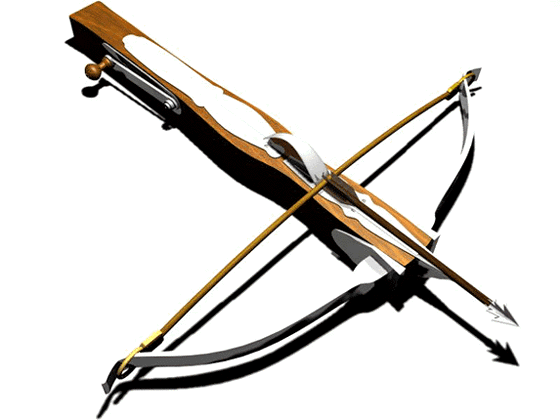
-- A crossbow is a special kind of bow where the arrow is attached to a simple machine that holds it in a ready-to-fire position until the “trigger” is releases it. Crossbow construction ranges from a simple wooden mechanism to a much more complex weapon incorporating several pieces of metal. Typically, crossbows are made of a composite of wood, horn, and sinew that make them much stronger and more efficient.

-- You may think that, because a crossbow is a “simple machine,” that you can’t use it in your fantasy story. The earliest known crossbows, however, date back to 5th century B.C., during the time of the Ancient Greeks. Ancient Chinese also utilized this weapon. If the ancients were smart enough to discover this weapon, why not your fantasy cultures?

-- A longbow has a faster shooting rate and are more accurate, but crossbows release more kinetic energy (thus have greater speed and can penetrate harder surfaces, even armor). Additionally, crossbows can be used after a single week of training, while longbows may take years to build up the strength to draw and use it. It’s up to you to decide whether or how to include the crossbow in your fantasy!


Included is a picture of the components of a recurve bow. Generally, the parts labeled in that illustration may be applied to other bows, as well; I’ve found them useful myself when detailing the specific actions of an archer. 


If you are writing extensively about bows, archery, or any function thereof, get a good reference book from the library and be sure to do your research. After all, nobody wants to write a climactic battle scene in which the fate of the world hangs in the balance of one misshot inaccurate badly-made arrow!


Thursday, January 12, 2012

Swords: Make it, Break it, or Fake it


What’s a good fantasy without a few sword-wielding heroes and heroines? That’s why, in today’s blog post, we’ll be looking at what exactly you need to know about swords (and, more importantly, what you don’t).

In fantasies, as in the great legends and epics of old, the primary weapon of choice is the sword. Soldiers stride around with giant broadswords dangling by their side, heroes defeat the villain with a clean swipe of their shining blade, and even Eowyn the shieldmaiden of Rohan (Lord of the Rings reference alert) had a sword to wield against the dreaded Nazgul witch-king.

Now, if you’re anything like me, swords don’t just confuse you. They frighten, intimidate, befuddle, and positively stupefy both you and your writing. Do you need to mention swordsmanship at all? If yes, how do you describe a sword, anyway? What do you do with a sword (besides swing it)?

Let’s start with an overview of the major types of swords.

1. Rapier
-- Basically, a fancy fencing sword that doesn’t do much damage. It’s quite long, so it keeps your opponent at a distance. However, it’s not durable and incapable of withstanding strong blows.
--This sword works best in situations like The Princess Bride, where fencing is a humorous way in which the hero and villain combat each other. Not for serious wounds, this one.

--This is a small knifelike sword that is sharp on both sides and comes to a deep point. The dagger is usually used for slashing at opponents in self-defense. In a variant on the dagger, the stiletto has an extremely sharply tapered the point and blunt sides, which make it ideal for stabbing (as opposed to slashing and hacking).
--Is your main character female in a dangerous, male-dominated society? Chances are, a full-on sword would be too obvious for her to have, but a dagger is just the trick to protect her from most attackers. The dagger doesn’t do enough damage for a soldier to use except as a backup weapon (or, if he’s the type that likes to show off, he may try to eat with it).  However, the stiletto in particular is easily hidden and perfect for assassination attempts.

--The sabre is especially distinctive for its curved, single-edged blade, which allows both slashing and stabbing. These swords are carried primarily by cavalry and are used when fighting on horseback. A cutlass is a variation on the saber that is used at sea by naval forces and pirates.
            --Got cavalry, navy, or pirates? Then here’s your ticket!

--As a historical sword used primarily in the Middle Ages, the longsword is often the weapon of choice in fantasy stories. The blade is slim yet strong and long, making it suitable for both slashing and stabbing. This is the weapon most used by infantry, as well as the knights-in-shining-armor of Camelot fame.
--If I’m allowed to be biased here, the longsword gets my vote for the ideal fantasy sword. Heavy enough to cause serious damage yet light enough for youths and less skilled soldiers to master, the longsword is excellent for battles and single combat alike.
--Note: the construction of the longsword changed with the introduction of plate armor in medieval times. If you’ll be featuring the longsword, it may be worth your while to consider the types of protection that your characters have available.

-- This sword is named for its particularly broad blade. It is slightly shorter than a longsword, mostly because of its great weight. The broadsword, while difficult to master and fight with, came into use after plate armor became widely used. It is particularly effective when using heavy blows to hack and slice. (Note that another sword named the broadsword is a heavy fencing blade, quite different from the broadsword I’m discussing here.)
-- Good for highly-trained muscled soldiers. Not so good for damsels in distress or your average worthy woodcutter’s son.

So there you have it. Of course, swords are a true art, and if you’re interested in them, you’ll find many more categories to study. I’ve included some pictures that have been very helpful to me for further observation. The first illustrates other types of swords, and the second details the different components of a generic longsword-like blade. The second picture is particularly helpful when trying to describe which portions of the sword the hero is grasping, swinging, sheathing, or cleaning.

Good luck and God bless in puzzling out the confusing world of swords in fantasy!


Thursday, January 5, 2012

The Hows and Whys of Naming God in Your Fantasy Story


As Christians, God plays the major role in most aspects of our lives. We may go to church, pray, and serve for God, but we should also extend our faith to our writing.

There are many ways to incorporate faith into writing. An allegory, like the Chronicles of Narnia (especially The Lion, the Witch, and the Wardrobe), entails an analogy or metaphor for Scripture. Pilgrim’s Progress also demonstrates this approach to writing. It’s very blatantly Christian, so in this style, God's name and presence will almost certainly be incorporated.

Another method of writing is much more subtle. As Christians, we incorporate our worldview into everything that we write. In this second method, the themes our work espouses are Biblical themes—loving our neighbor, sacrifice, service. This is the method J. R. R. Tolkien used in The Lord of the Rings. In this second method, God may or may not be mentioned, but either way, Christianity is upheld.

If God does come up in your book, then He must have a name.  Here are a few thoughts on the subject.

1. God
  • Pros: straight and to-the-point. There’s no confusion here about whether you’re really referring to the Christian God or not.
  • Cons: it’s very obvious and pushy if you’re writing for non-Christian market 

2. Biblical Name (e.g. Jehovah)
  • Pros: Not quite so obvious as saying “God.” Still incorporates God as He chooses to be called.
  • Cons: Again, can still be rather pushy. Non-Christians may be dissuaded by an overly “religious” tone.

3. An attribute (e.g. the One, Guide, Voice, Protector, etc.)
  • Pros: Not so obvious and definitely not so pushy as a direct Biblical name.
  • Cons: Often overused. More importantly, it’s impossible to sum up all that God is with only one word or one attribute. 

4. A made-up name (e.g. Illuvatar from Tolkien’s works, or Aslan in Narnia)
  • Pros: The least pushy of the lot. Creative and different. Can work better in the context of a different world.
  • Cons: Difficult to “create” a unique, powerful-sounding, beautiful name that is worthy of God’s majesty. Also, may or may not be associated with the Christian God.

Be sure to give this topic a whole lot of thought and prayer. One of our most important responsibilities as writers is to represent God as He is.  God bless as you embark on this most important decision!


Sunday, January 1, 2012

The New Year in Fantasy


Happy New Year, everyone! Welcome to the year 2012!

That is, unless you're one of the many people around the world who celebrate the new year at other times. For example, Chinese New Year this year is not until January 23. In the Jewish calendar, the new year, Rosh Hashanah, was celebrated September 29th of 2011. And even in the Western world, up until about 1750 A.D., the new year was celebrated on March 25th. (If you're interested in finding out other dates of new year's celebrations, you may find this Wikipedia article on the New Year informative.)

In fact, a quick glance through all the new years around the world reveals that there have been celebrations in winter, in spring, in fall, and in summer to celebrate the coming of the "new year."

This brings us to an important point: there is no one right new year. This also means that, for your fantasy world, there's no reason to stick to January 1st as the time to usher in the next year.

Why is the particular date of the new year so important, though? Couldn't we just ignore it and move on with life? Well, the obvious answer is, yes. Certainly. But let me give you a few reasons to include--or at least think about--when the new year occurs in your fantasy world.

  • Very nearly all cultures in our world celebrate the new year at some time during the year. Why should a fantasy world be any different? It'll make your culture seem more true-to-life.
  • The new year is often a time to gather with family or close friends. If you need an excuse for your main character's slightly insane uncle to kidnap her, why not let the action happen during the new year celebrations, while the family is too busy toasting with rice wine to notice?
  • Also, the new year is a time to make new goals, change direction, and acquire a new purpose in life. You can use this time of year to have your character reflect on his or her past, and plan for the future.
  • Finally, the new year is often a time of romance. If your hero and heroine haven't quite got up the courage to have a sweet moment together, then the dancing and celebration of New Year's might be the perfect time to make a match.

So maybe, by now, you're convinced that a new year celebration might be helpful in your book. Well, how do you go about writing one? Actually, the process is quite simple.
  1. Decide on a season. Is this a harvest-time new year? A wintry, snowy, cold, and bleak new year? A spring new year, with new life and new growth in the air? A summer new year, with scorching heat and crops growing strong and tall under the sun? (Remember, too, that your world's calendar system will have an important impact on the new year. Does it celebrate lunar or solar months? How does it keep track of the passing of time?)
  2. Decide on particular customs. Is the new year a time for romance, or is it more for family? Is it a big party with lots of food or a small gathering with a few near and dear to your heart?
  3. Have your characters look back on the previous year. Any milestones?
  4. Have your characters look ahead at the new year. You could foreshadow difficulties and danger, you could give them a change of heart, or you could leave them in ignorant bliss about the path that lies ahead of them.
Whatever you do, and however you write, make sure it's consistent with your characters, your story, and your world. Enjoy!